

Project Status
There are over 500,000 glass photographic plates in the Harvard Plate stacks, exposed in both the northern and southern hemispheres between 1885 and 1993. This 100 year coverage is a unique resource for studying temporal variations in the universe. Because there are so many plates, our first plan was to use commercial flatbed scanners instead of the traditional scanning microdensitometer. Because that method was also too slow, we have built a specialized scanner.
A Microsoft WMV format video (9.4 MB) shows the scanner in operation.
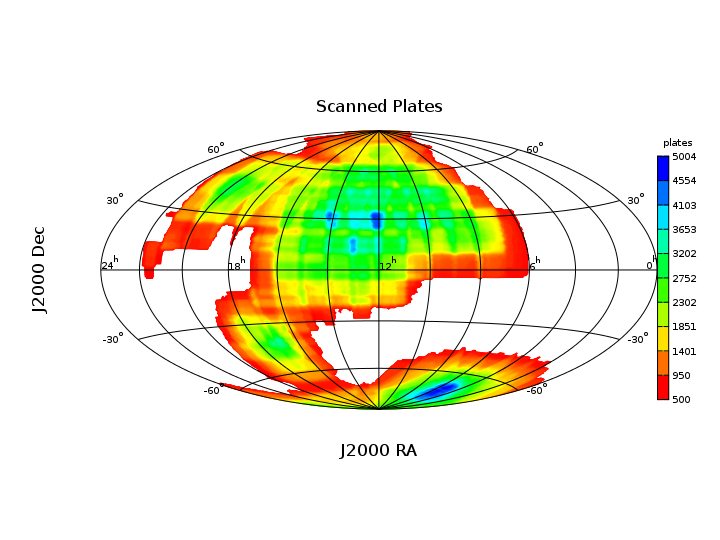
 We have currently performed 57144 plate scans of 57019 unique plates. Click on the thumbnails to the left to view the current sky coverage in equatorial and galactic coordinates.
We have successfully performed accurate World Coordinate Systems (WCS) fits for 56581 of these plates. Multiple exposure fitting provides us with 63178 sets of WCS coordinates. As of June, 2008 the WCS fitting procedure procedure was upgraded to use the astrometry.net software in conjunction with Jessica Mink's WCSTools
We have currently performed 57144 plate scans of 57019 unique plates. Click on the thumbnails to the left to view the current sky coverage in equatorial and galactic coordinates.
We have successfully performed accurate World Coordinate Systems (WCS) fits for 56581 of these plates. Multiple exposure fitting provides us with 63178 sets of WCS coordinates. As of June, 2008 the WCS fitting procedure procedure was upgraded to use the astrometry.net software in conjunction with Jessica Mink's WCSTools
In addition to building the scanner, the NSF grant enabled development of pipeline algorithms that allow photometry across a variety of emulsions and telescopes. From 52696 plates, our photometry pipeline has generated approximately 3,366,000,000 magnitude estimates covering a span of 103 years. These magnitudes have been matched with 85,498,000 GSC2.3.2 catalog stars to generate 11,950,000 lightcurves with at least two good points.
A parallel effort is underway to digitize the key logbook information necessary for processing the plates. In May, 2007, the late George Champine completed imaging 79,470 pages from 813 logbooks and unbound sheets. Volunteers locally and at the American Museum of Natural History in New York City are now helping us transcribe these images. When combined with previous work to transcribe the card catalog and experiments with commercial transcriptions, we now have plate centers for 325,845 plates.
We have low resolution images of 58,749 plate jackets and of the ink markings from 51,350 plates.
Except for photometry outside the M44 region, the database and the logbook images may be accessed from this site. We regret that access to the scanned data is not yet fully implemented.
Current Scanning Progress
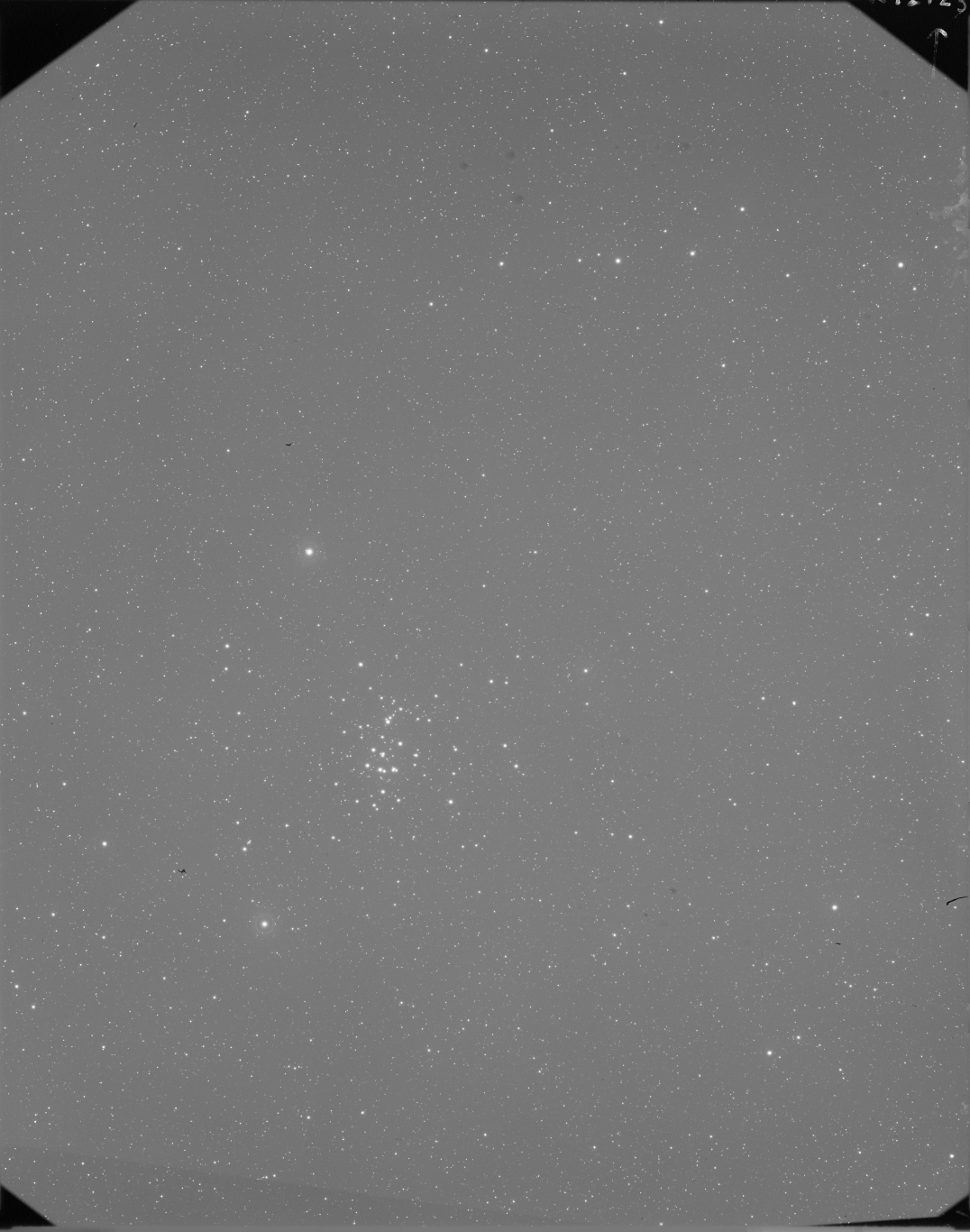 The initial set of approximately 600 scans was concentrated in the region of the sky around M44 because the photometry of this cluster is well known and the results are being used to develop the photometric pipeline. This image is of plate ir12723 of M44 taken on February 15, 1974 from Oak Ridge with the 8-inch Ross Lundin. The exposure was 15 minutes centered on 08h36m07s R.A. and +20h51m57s Declination.
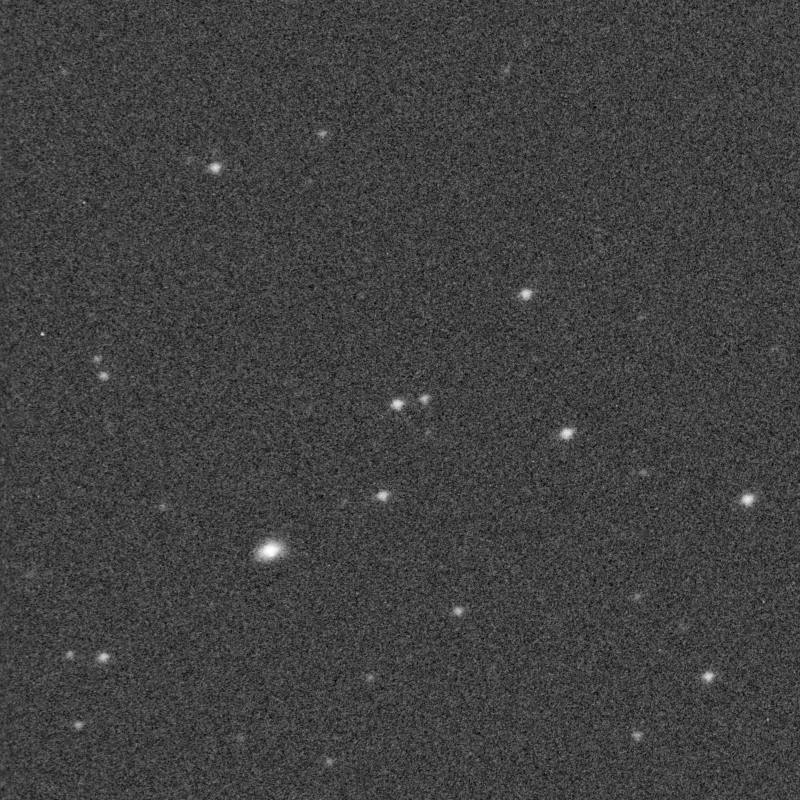 The next set of 1413 plates scanned were of 3c273 in order to improve the existing long-term photometry of this quasar. The set included the 1000th plate scanned by the project on October 25, 2007.
The 3c273 quasar is at the center peak of the "w" asterism in this extract from plate mf16956 taken on June 23, 1932 from Bloemfontein with a 45 minute exposure using the 10 inch Metcalf Triplet.
The next set of 1413 plates scanned were of 3c273 in order to improve the existing long-term photometry of this quasar. The set included the 1000th plate scanned by the project on October 25, 2007.
The 3c273 quasar is at the center peak of the "w" asterism in this extract from plate mf16956 taken on June 23, 1932 from Bloemfontein with a 45 minute exposure using the 10 inch Metcalf Triplet.
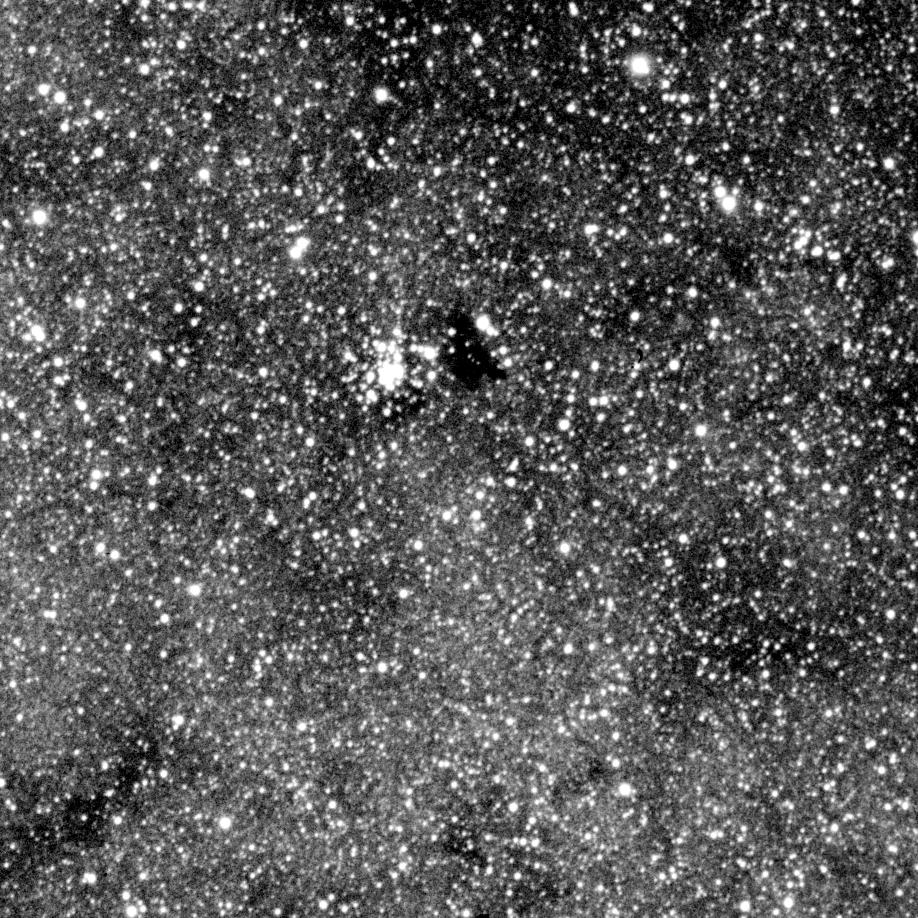 The next set of 868 plates covers the region of Baade's window where we are testing our photometry pipeline in the region of one of the densest star fields in the Milky Way and we hope to obtain rates of novae and other burst phenomena near the center of our galaxy. This set includes the 2500th plate scanned by the project on February 28, 2008. The cluster NGC6520 is near the center of this image extracted from plate rb16468 taken on August 28, 1949 from Bloemfontein with a two hour exposure using the 3 inch Ross Fecker.
 We scanned plates for the quasars PG0844+349, PG2130+099 and PG1211+143.
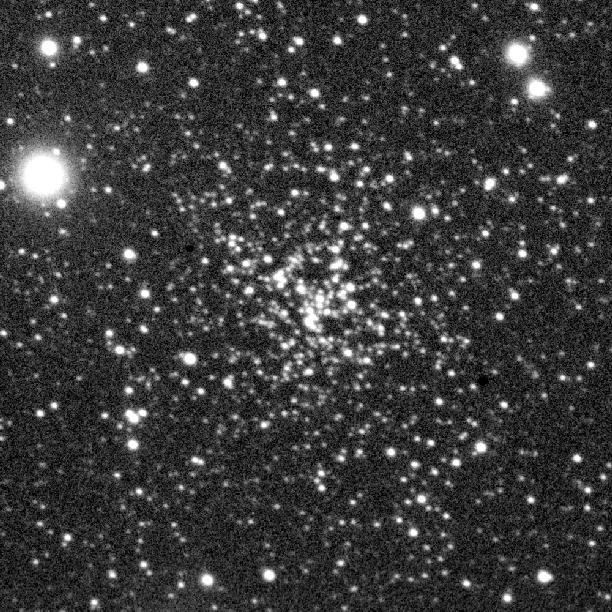
Scanning for the quasar PG2130+099 included the 4000th plate scanned on January 8, 2009 and for quasar PG1211+143 included our 5000th plate scanned on April 23, 2009. We completed scanning the field of view region of the Kepler satellite. The image on the left is NGC6819 which is one of the more prominent clusters in the Kepler field. This image comes from plate mc36426 taken with the 16-inch Metcalf Doublet at Harvard, Massachusetts with a 60 minute exposure on July 4, 1949. Thanks to Dave Latham, we are using the Kepler Input Catalog to refine the colorterm processing of our photometry pipeline. From 3750 Kepler field plates, we have 342,580,000 magnitudes and 890,000 lightcurves with at least two good points from the 3,243,000 stars matched to the Kepler Input Catalog. The more accurate photometry in this catalog has simplified our task of identifying unusual stars.
We scanned plates for the quasars PG0844+349, PG2130+099 and PG1211+143.
Scanning for the quasar PG2130+099 included the 4000th plate scanned on January 8, 2009 and for quasar PG1211+143 included our 5000th plate scanned on April 23, 2009. We completed scanning the field of view region of the Kepler satellite. The image on the left is NGC6819 which is one of the more prominent clusters in the Kepler field. This image comes from plate mc36426 taken with the 16-inch Metcalf Doublet at Harvard, Massachusetts with a 60 minute exposure on July 4, 1949. Thanks to Dave Latham, we are using the Kepler Input Catalog to refine the colorterm processing of our photometry pipeline. From 3750 Kepler field plates, we have 342,580,000 magnitudes and 890,000 lightcurves with at least two good points from the 3,243,000 stars matched to the Kepler Input Catalog. The more accurate photometry in this catalog has simplified our task of identifying unusual stars.
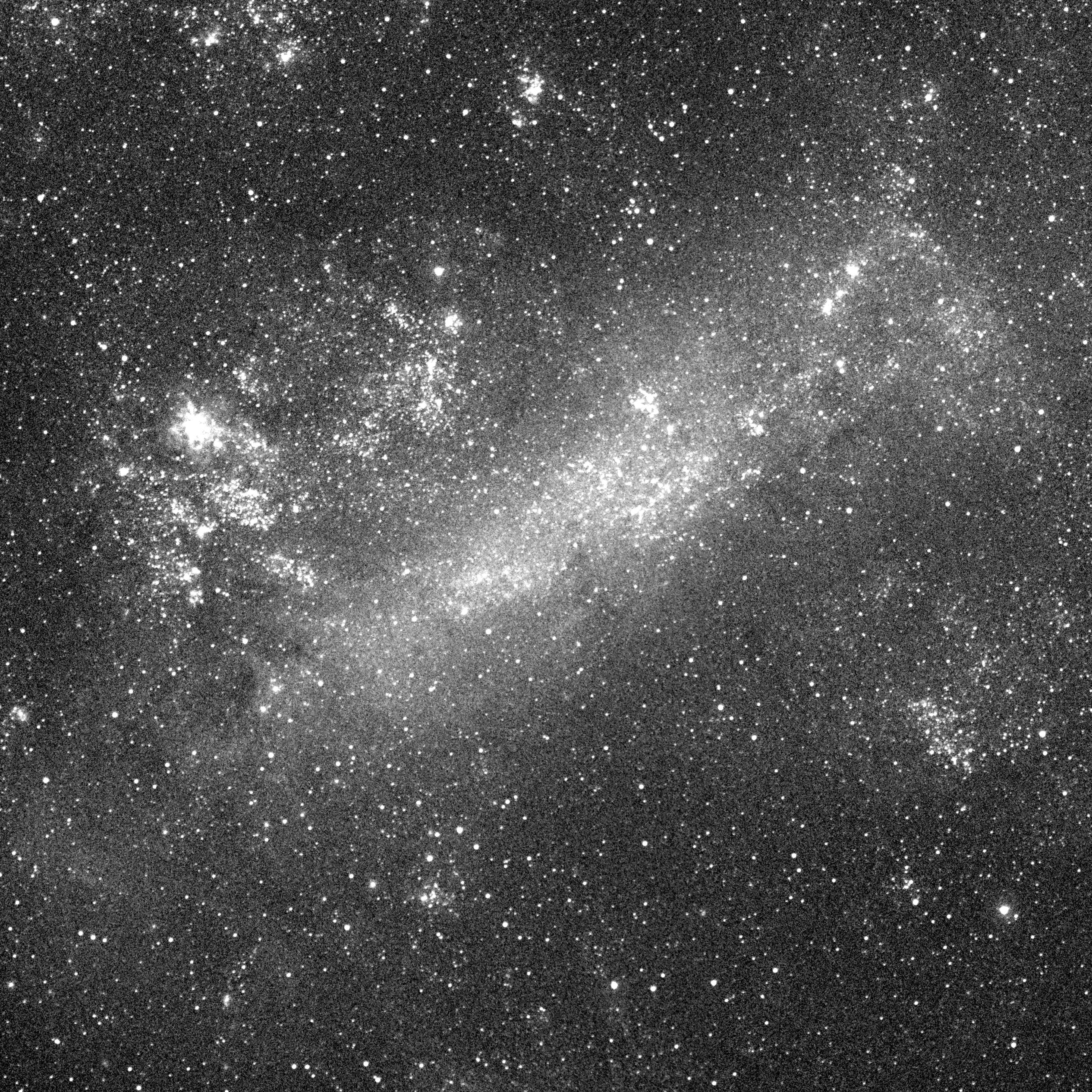 We scanned plates of the Large Magellanic Cloud. The image on the left was extracted from plate dsb00978 taken from Mt. John, New Zealand with the 0.042 m Damon South Blue patrol telescope on December 8, 1982 using a 30 minute exposure. Our 10,000th DASCH plate scan occurred on July 8, 2010 while scanning
in the region of the Large Magellanic Cloud. In September, we took time out from
the LMC project to fill in our coverage for the Baade's window and to
scan plates of Tc 1, a planetary nebula in which C60 and C70 fullerines have recently been detected. We also took time out to scan plates for interesting stars discovered with Sumin Tang's data mining algorithms.
We scanned plates of the Large Magellanic Cloud. The image on the left was extracted from plate dsb00978 taken from Mt. John, New Zealand with the 0.042 m Damon South Blue patrol telescope on December 8, 1982 using a 30 minute exposure. Our 10,000th DASCH plate scan occurred on July 8, 2010 while scanning
in the region of the Large Magellanic Cloud. In September, we took time out from
the LMC project to fill in our coverage for the Baade's window and to
scan plates of Tc 1, a planetary nebula in which C60 and C70 fullerines have recently been detected. We also took time out to scan plates for interesting stars discovered with Sumin Tang's data mining algorithms.
On May 19, 2011, we completed the move of our photometry pipeline to three nodes on the Odyssey cluster.
We completed scanning our first batch of the large 8"x14" A
series plates for the above fields . These plate scans produce 2GByte mosaics. This switch from the 8"x10" plates which make up the bulk of the collection required a number of procedural changes and slowed the scanning rate by nearly a factor of three. We scanned our 20,000th plate on January 26, 2012 after switching back to 8"x10" plates to scan some candidate stars in Scorpio.
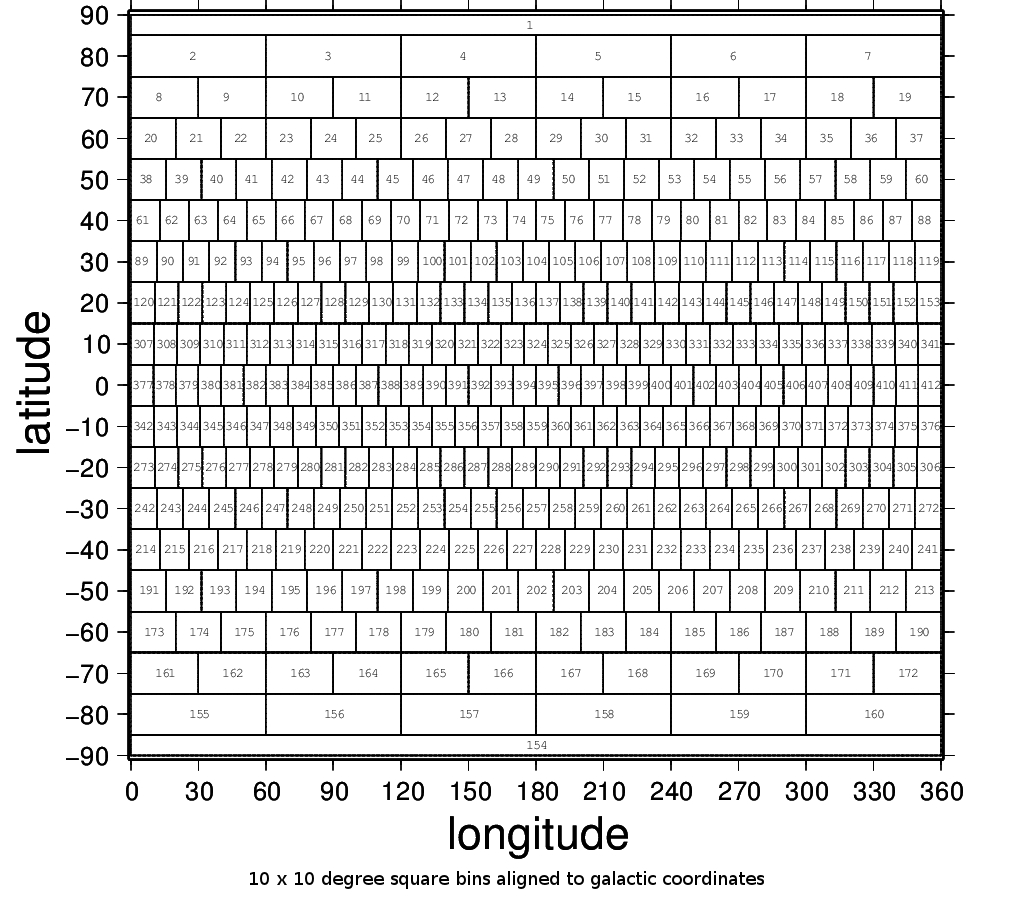
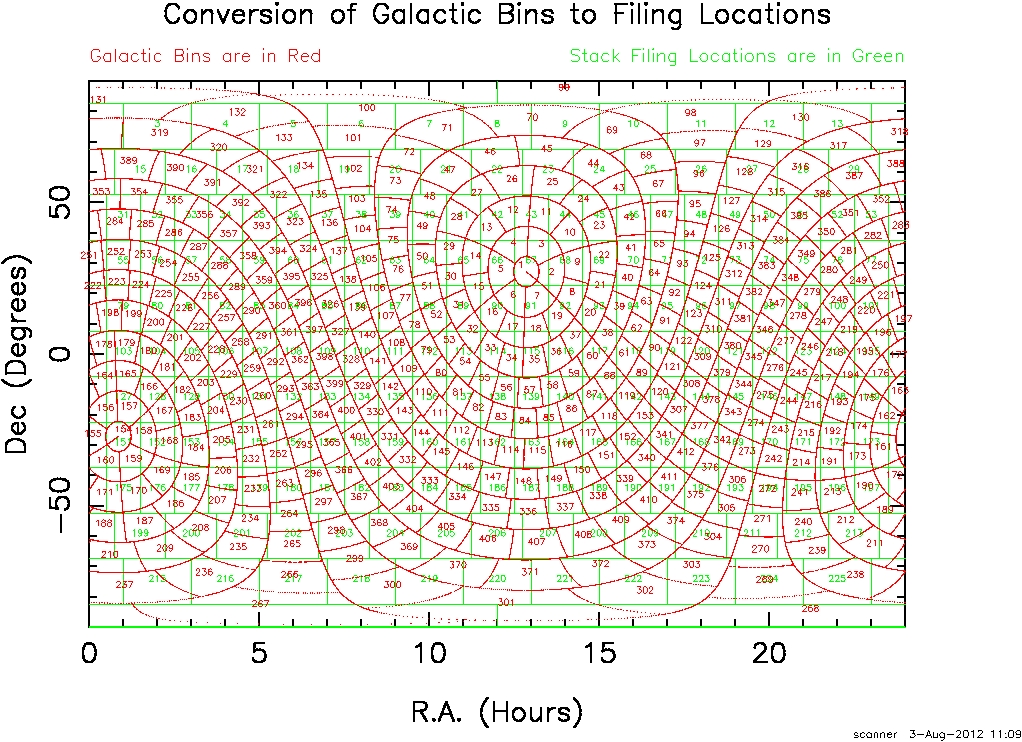 We are currently performing a methodical all-sky scan of the collection beginning at the North Galactic Pole. The maps at left shows the planned sequence to scan 412 ten degree square regions in galactic coordinates.
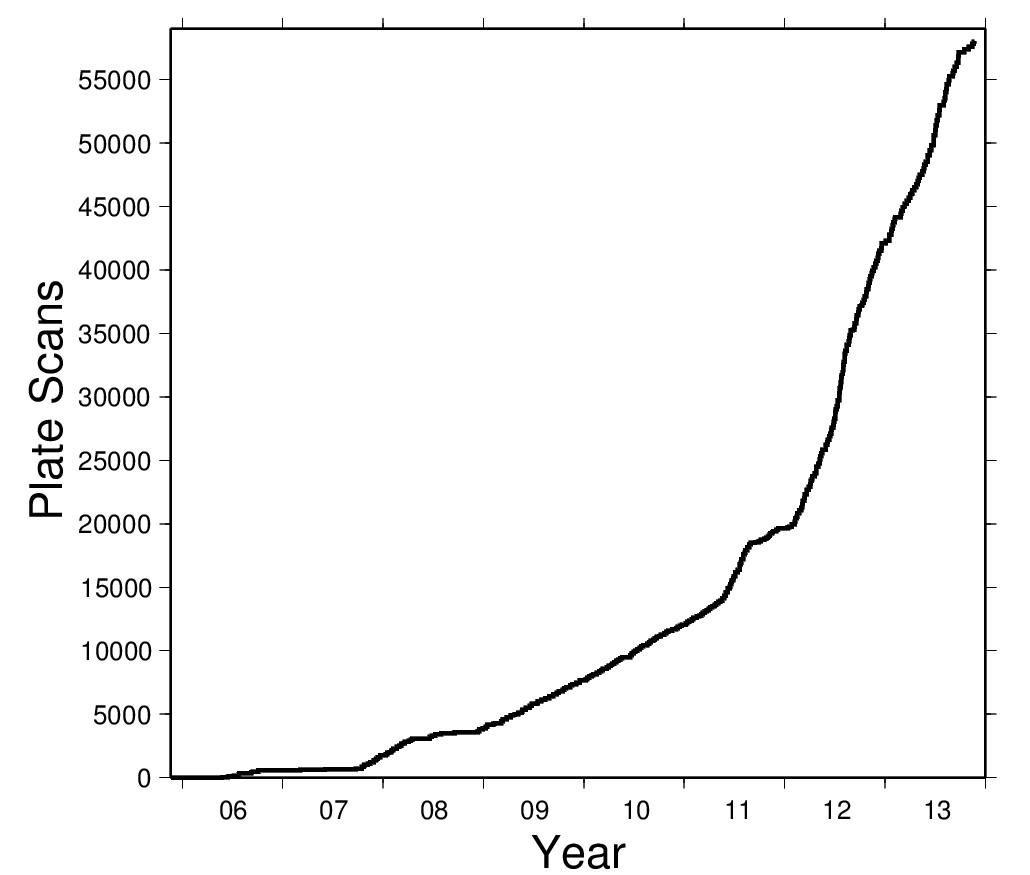 We are currently working on Data Release 3. The graph on the right shows that We scanned our 50,000th plate on June 26, 2013. On September 23-25, 2013 we assisted the New Horizons mission by scanning 843 Lowell Observatory plates of Pluto taken from 1930 to 1951. The scanning rate has temporarily slowed while we hire new staff to reach our target rate of 400 plates scanned per day.
Acknowledgements
The DASCH project at Harvard is grateful for partial support from NSF grants AST-0407380, AST-0909073, and AST-1313370; which should be acknowledged in all papers making use of DASCH data.We acknowledge the one-time gift of the Cornel and Cynthia K. Sarosdy Fund for DASCH, and thank Grzegorz Pojmanski of the ASAS project for providing some of the source code on which the DASCH web-interface is based.
The ongoing AAVSO Photometric All-Sky Survey (APASS) has improved DASCH photometric calibration and is funded by the Robert Martin Ayers Sciences Fund.
Last updated Mon 02 Dec 2013 11:51 AM by Edward J. Los.